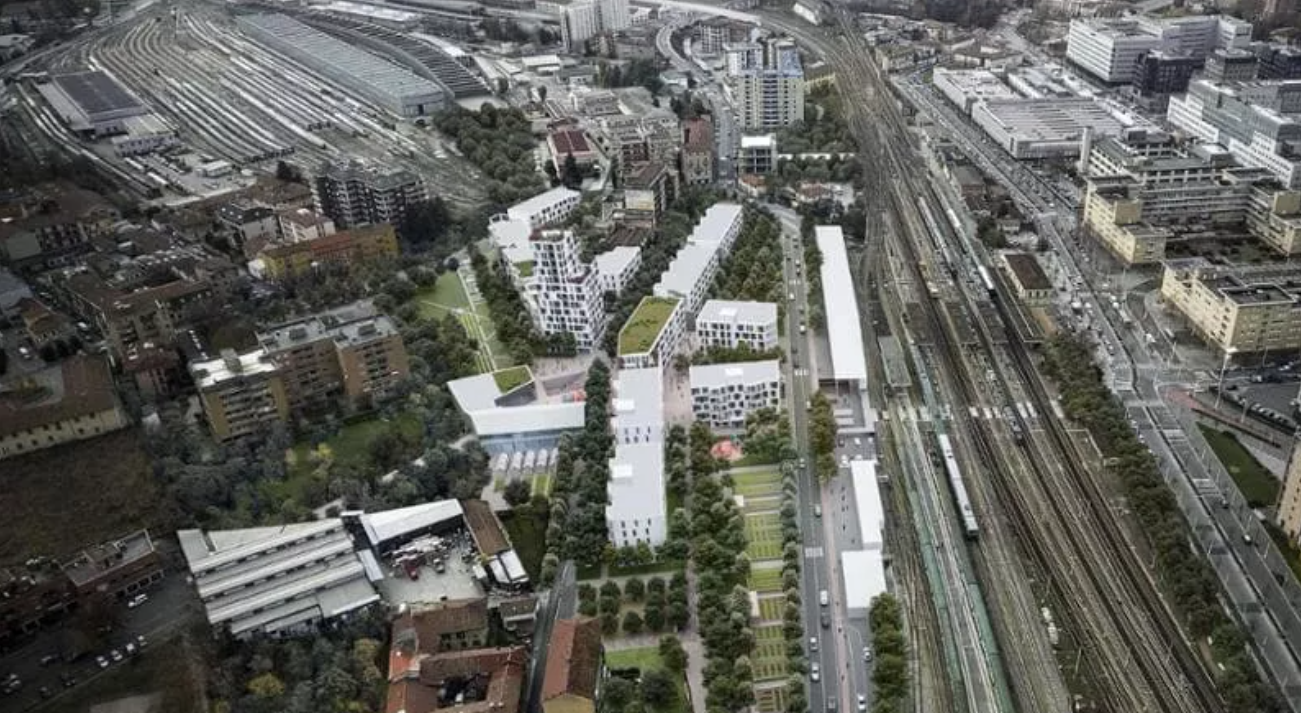
Redevelopment of the Greco-Breda railway station: social housing and public green space project approved.
Redo SGR will build it, with the goal of connecting the two neighborhoods currently separated by the railway
Social co-housing, residences for university students, and new green areas with pedestrian and cycle paths. Almost nine years after the agreement on the redevelopment program of the seven former disused railway yards in Milan, the first implementation plan dedicated to the Greco-Breda Railway Yard has been definitively approved. After the initial green light last December, the City Council has approved the "L'Innesto" project, a project that aims to reconnect and connect the neighborhoods around the Greco-Pirelli area of Milan, which until now have been separated by railway tracks. The project will be implemented by Redo SGR, which, in addition to being the implementing entity together with the FIL Fund, also owns the area: in 2020, it purchased the yard from Ferrovie dello Stato Italiane for €4.8 million.
The project will be presented to residents on Tuesday, March 17, in the parish of San Michele Arcangelo in Precotto, in the presence of Deputy Mayor and Councilor for Urban Regeneration Anna Scavuzzo, who already stated in December: "In the coming years, a completely new neighborhood will be built here, aimed at young people, with affordable housing, greenery, and services for citizens, capable of attracting residents and bridging the current gap between the areas to the east and west of the yard."
Thus, 63,000 square meters will be transformed—so they promise—into a modern, carbon-neutral neighborhood dedicated to social housing, of which more than 60% will be dedicated to green spaces and public areas. One of the main objectives is to improve connections between neighborhoods currently separated by the railway, working on Via Breda, Via Rucellai, Via Gilardi, and the areas towards Sesto San Giovanni and Torcello, between the 2nd and 9th districts. Thanks to new pedestrian walkways and a railway underpass, it will be easier to walk to Bicocca, Precotto, and the University, connecting Via Rucellai directly to the Bicocca neighborhood.
Approximately 21,000 square meters of the area will be dedicated to social housing, divided into various formats. A portion, approximately 8,300 square meters, will be designated for subsidized housing with prices more accessible than the market, rentals with a future purchase agreement, and co-housing projects. Another portion, at least 10,600 square meters, will be dedicated to residences for rent with moderate or agreed rents, social housing, and subsidized university residences for students. Finally, at least 2,000 square meters will be designated for socially rented residential housing. In addition to the housing, space for commercial services and shops will be provided on the ground floors of the new buildings, totaling approximately 3,000 square meters, as well as an Energy Center that will serve to distribute district heating in the neighborhood. Meanwhile, the redevelopment of the Milan Greco Pirelli station, carried out by Rete Ferroviaria Italiana in conjunction with the City of Milan, is already underway. The project, funded with over €11.3 million, is part of the Integrated Urban Plans investments linked to the PNRR (National Recovery and Resilience Plan). To facilitate access to the railway for those arriving from the Precotto side, an underground plaza will also be created at the underpass that will directly connect the station.
Among the planned projects is the redevelopment of Via Breda: a section of the street will become the main pedestrian thoroughfare of the new neighborhood, while a new road will be built next to the railway. The green heart of the project will be an area of approximately 39,000 square meters dedicated to public spaces, including parks, squares, and pedestrian and cycle paths. A new Viale dei Gelsi will also be created along the current Via Breda, which will include a community garden and a social agricultural greenery project developed in conjunction with the Food Policy Area. In total, approximately 29,000 square meters of greenery and the planting of 700 new trees are planned, designed to improve the quality of public spaces in the pilot area of the City of Milan's Air and Climate Plan.
Link to the website: https://milano.repubblica.it/c...
Post a comment