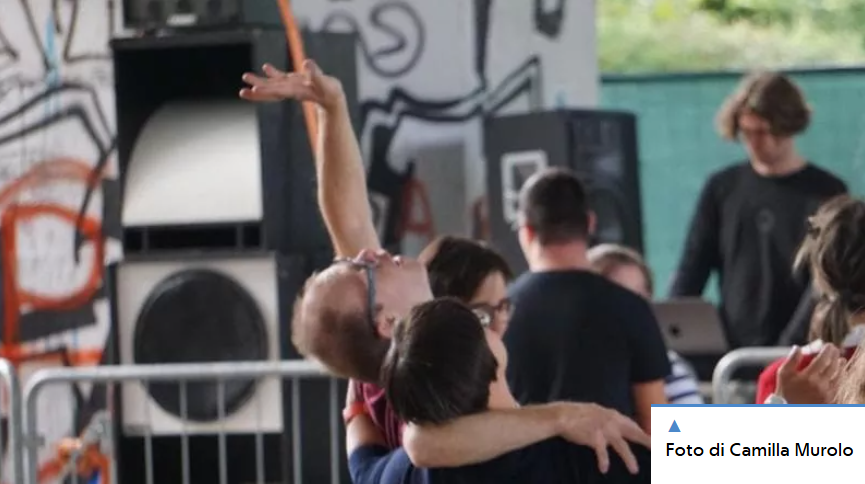
Milan, evenings at inclusive nightclubs where everyone can dance: "To truly feel equal."
The Unisono project created a format to combat the social exclusion of boys and girls with intellectual disabilities
My son was so happy, he didn't stop talking about the evening for a moment. Thank you so much." This is just one of the messages the Unisono kids received from the mother of a young man with autism spectrum disorders. Simple words that, however, as project coordinator Arianna Gatti explains, "brought tears to everyone's eyes."
The Unisono project was born in 2021 in Milan with a specific goal: to propose an inclusive clubbing format to combat the social exclusion of young people with intellectual disabilities and autism spectrum disorders. That is, the disco for everyone.
The idea had already been taking shape a few years earlier. In 2019, Pietro Colombo and Giulio Colombo, then high school students, came across an English article about the experience of inclusive clubbing in Manchester. They immediately decided to bring the format to Milan, adapting it to a more open vision: evenings designed for everyone, not just people with disabilities. Within a short time, the project found a place in the hearts of many, eventually becoming an initiative of Walter Vinci Onlus and winning a tender from the City of Milan. Before organizing the evenings, however, the team of young people decided to do their utmost to prepare. "We met with professionals and people with intellectual disabilities to understand from them the barriers in the clubbing world," explains Gatti. This is how truly accessible events were born. The music is lowered, and interactive maps of the venue are distributed before the evening: "This way, the young people can familiarize themselves with the space. When they enter, they already know where to go to pay or get a drink; in a place they're unfamiliar with, they often wouldn't." Even the music is chosen with great care: on the advice of music therapists, songs with particularly dark or sad lyrics are avoided. Furthermore, where space allows, a "decompression room" is set up, designed to help people gradually adjust to the volume of the music both upon entry and exit. Unisono's work on inclusion also extends to its communication. "Even the event promotion must be inclusive," says Gatti: no overly complex or chaotic posters, but clear and easily understandable writing. "After the first events, many of the kids told us that it was their first time dancing or that they were staying out so late at night, the first time they could truly feel like they were on par with their peers." This is precisely why the evenings are not reserved for people with disabilities. "If they were," explains Gatti, "we would have the opposite effect: we would distance them even further from social inclusion. But here people come just because they want to have fun in company."
Link to the site: https://milano.repubblica.it/c...
Post a comment