Do the right thing, Lebanese students stranded in their homeland say: "The war had other plans for us."
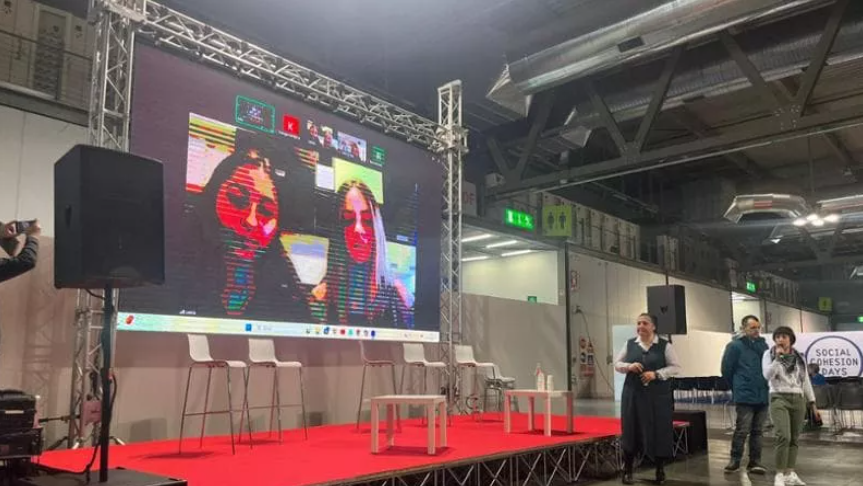
The young people who were supposed to participate in the critical consumption fair were unable to make it to an event with their Milanese peers: there was emotion in the room due to the video link
"Coming to Milan would have meant realizing a dream: making the cry of us young Lebanese heard. But the war had other plans." Celia tells her story from Beirut, where she fled, via video link. Her eyes are shining as she speaks to the students of the Russell and Boccioni high schools in Milan and the Parini high school in Seregno, with whom she and her classmates were supposed to meet in person. The meeting was scheduled for the opening day of the twenty-second edition of the "Do the Right Thing" fair. "We are grateful for this opportunity, even if we expected it to be different, a joyous one. We knew, however, that, somehow, we would be able to make our voices heard," she explains.
She and seven other students from the multi-religious school in Ain Ebel, in southern Lebanon, a few kilometers from the border with Israel, were supposed to be here, in Milan, together with their Italian peers. In the end, however, the only one who managed to reach Italy was Sister Maya, the principal of the Ain Ebel school. "You are applauding now," she says, addressing the Italian students in a tone that doesn't hide her anger for what her students are going through, "but where we come from today they are applauding at the funerals of their fellow villagers." Then she asks a simple, direct question: "What does home mean to you?" From the audience, many answers come: "peace," "family," "security." “What if they told you you had seven minutes to leave everything behind?” Sister Maya continues. There, silence falls. “I know it’s a difficult question, but this is what happened to my students.” Of the eight students who were supposed to connect, only three were able to participate in the video call. The other five had to leave their homes to move to Beirut, in search of a safer place. Rebecca and Leticia, two high school seniors, instead decided to stay in their neighborhoods. “It doesn’t matter where you come from: never stop believing in your dreams. With hard work, you can achieve anything,” Leticia says, addressing her Italian peers. In a serious but proud tone, she recounts her experience: “Despite the war, I didn’t run away. I continued studying, took tests and interviews, and even managed to win a competition for a six-month program in Paris.” She didn’t have a stable connection at home: the Wi-Fi only worked at school. “That’s why she received the news of her admission a week late.” Sister Maya only lets a smile escape her face when introducing her students. She proudly talks about the Ain Ebel school, a place where Shiite and Christian students live side by side, who, in other contexts, would risk clashing. There, instead, they collaborate on the "Fratelli tutti" project, which connects students from different countries through exchanges and correspondence, in the hope of actually meeting one day.
"I didn't leave," says Rebecca, in the same room as Leticia. "I stayed here to volunteer because it seemed like the right thing to do. Seeing my friends' lives move forward while I remained stagnant was heartbreaking, but I learned resilience. Be grateful for your family and your school." Her words are followed by prolonged applause.
At the end of the meeting, some of the Italian students find the courage to leave a message for their Lebanese peers: "You are an example of courage and resilience. You are the hope for a dignified future. I send you, even from a distance, all the best I can." Thus concluded a meeting that everyone present had imagined differently, but which, precisely for this reason, left an even deeper mark on the students who never turned their attention away from those who were not as fortunate as them.
Link to the site: https://milano.repubblica.it/c...
Post a comment