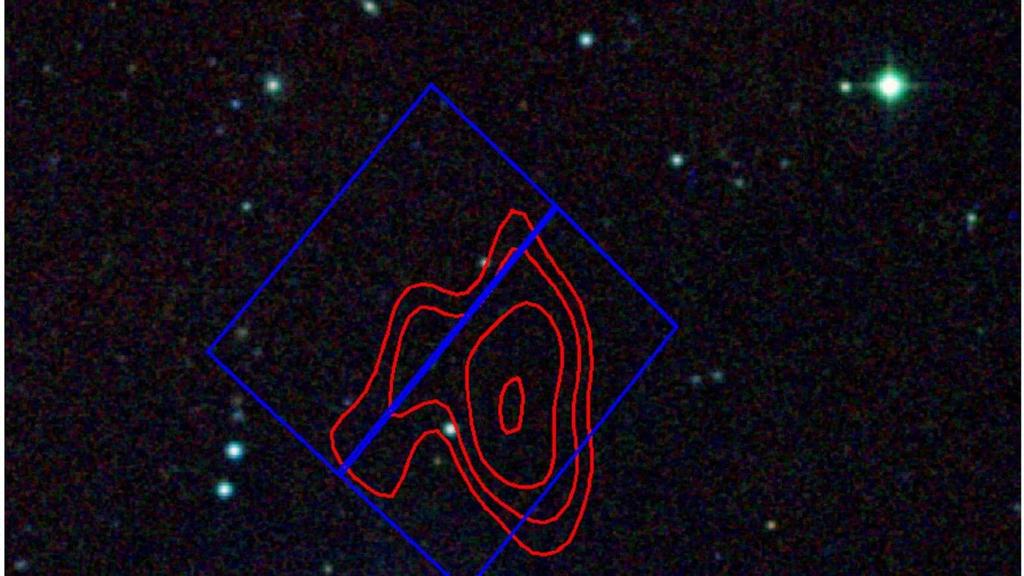
Cloud-9, the first starless "ghost galaxy" discovered at the University of Milan Bicocca
It was researcher Alejandro Benitez-Llambay of the Physics Department of the University of Milan-Bicocca, together with an international research group, who identified a dark matter halo composed of hydrogen completely devoid of stars located approximately 14 million light-years from Earth. Thanks to his discovery, the study of this astrophysical object was able to confirm the underlying theoretical cosmological model that describes the formation of the structures of the universe. Not surprisingly, Cloud-9 is the first certain candidate for the role of a RELHIC (Reionization-Limited H I Cloud) astrophysical object, already theorized by the research group, but never observed before. It would be a collection of dark matter that, despite the presence of hydrogen, remains devoid of stars.
For this reason, it is also nicknamed a "failed" or "ghost" galaxy. Cloud-9, despite having a significant mass of hydrogen, would not be able to retain enough gas to overcome the thermal pressure and trigger star formation within it. This explains why it differs from other galaxies. "Cloud-9 is not a galaxy, despite its mass and the presence of gas," specifies Alejandro Benitez-Llamba, underlining the uniqueness of this astrophysical object. The identification of Cloud-9 was made possible thanks to the use of unprecedented, cutting-edge telescopes, including Hubble, space telescope pointed for a total of 13 hours (eight orbits) at the dark matter halo. His research dates back to 2023, in China, when the FAST radio telescope intercepted its radio signal, which was then observed by the VLA radio telescope in New Mexico. However, definitive confirmation of its uniqueness came only thanks to the use of Hubble, definitively confirming the absence of stars in the area extending over 4,500 light-years.
"The observations with this telescope were a very complex logistical challenge," Alejandro specifies, explaining how Hubble is operating in "reduced mode" due to its long orbit and the resulting malfunctions. "The failure to detect stars within this cloud is a fundamental step in validating the ?CDM model (the theoretical framework that describes the evolution and formation of structures in the universe)," adds the researcher from Milan-Bicocca. The discovery shows the boundary between dark matter halos that become galaxies and those that remain starless, "ghosts." Cloud-9 thus opens new perspectives on the study of galaxies and the processes that govern their formation, presenting itself to future researchers as a useful tool for reconstructing and explaining more precisely the formation of the structures of the universe.
Link to the site page: https://milano.repubblica.it/c...
Post a comment